
History

An ancient Dartmoor tradition
The tradition of walking, carrying the dead, to a dedicated burial place has deep roots on the moor. This picture was created by local renowned artist Alan Lee (used with permission and thanks for his beautiful work). It evokes something of the famous Lych way – the long walk for people of Dartmoor Forest parish to Lydford.
One of the earliest actual written records from people living on the moor is a petition from the people of Pizwell and Babeny in 1260 to the Bishop of Exeter, asking if they could be permitted to carry their dead to Widecombe rather than Lydford, a much shorter distance, particularly in winter, so people were mindful of energy expenditure even then.
Long before this, there was the carrying of the dead to the many burial mounds and cists on the moor. These were often in high places and, if lower, with avenues of stones leading towards them.
Certainly how our ancestors cared for the dead has left some of the most visible and interesting remains, be it the frequent burial cairns in high places or more discrete cists, buried in the earth and peat, such as the fascinating one’s recently uncovered, for example on White Horse Hill.
 There is no clear evidence of historical human burial actually within Epona, though twenty years ago, whilst mid conversation as to whether natural burial would be a good thing there, the stem of a clay pipe was seen in the hedgerow. Not only did it turn out to be whole, which is quite unusual for one found out in the elements, upon picking it up and turning it over, it transpired its form was of a skull with the tendrils of leaves growing around it! (Image: sketch of clay pipe found at Epona).
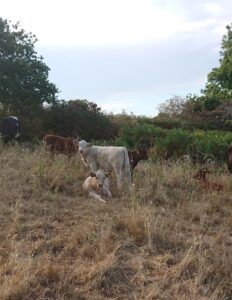 The approximate half acre of land within the 24 acres where the natural burial ground is, on one of the 1840’s tythe maps is in a paddock that was called “Three Cowsers.” Another map calls it three corners but we preferred “Cowsers,” and on mentioning it to a neighbouring farmer, she said “well there was a time a farm was rich if you had three cows, for it meant you had surplus milk to sell.”
On the land there was also “Great Orchard” and Liittle Orchard”, of which we have replanted one..
“We cannot, of course, save the World because we do not have authority over its parts. We can serve the world though. That is everyone’s calling, to lead a life that helps.” Barry Lopez