
“Regenerative farming is what the public will want increasingly as the benefits of these practises become ever more apparent: more nature, cleaner water, more delicious food, lower production costs, less flooding, to name a few. We need to eat less meat but better, and we need to have the choice of food from farms that nurture.
The regenerative farming practise we are developing shift the emphasis back to natural processes which creates a great environment for wildlife and animals to thrive. The question is how we bring this shift into the public conscience.”
Butcher, Beef and Deer Farmer, Andy Gray, Chair of Devon County Agricultural Association. South West Farmer, June 22.
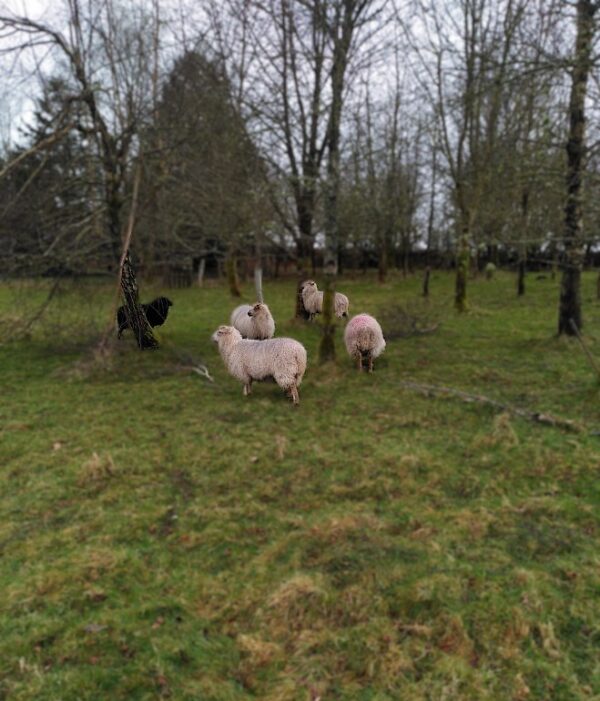
Sheep and ponies grazing in wood pasture

Epona is 24 acres of land bought by local not for profit organisation RegenCo (short for the Regeneration Company) of which Epona Natural Burial is a part, overseeing the natural burial aspect, in the year 2000 for the purpose of regeneration.
At the time Scientist James Lovelock felt the most important thing we could do for Gaia was plant trees, and so Epona, which was predominantly modified grassland (so species poor), was bought with this in mind. As well as planting trees, already the understanding was growing that natural regeneration could be even better both for diversity (and the trees themselves), than planting. That in the slow build of succession, with all its messy stages both above and below ground, the conditions are created in which pioneers take root and wildlife flourishes.
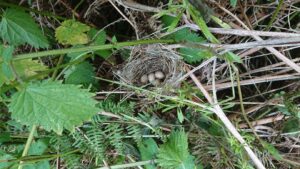 Alongside natural regeneration, Epona is a small holding with an interest in meeting food, fibre and timber needs too, for a way must ultimately be found to integrate these things. (Picture left: Whitethroat nest among natural regeneration at Epona.)
There has been a small flock of sheep for many years, now grazed in the winter months, and we have planted with community support a willow bed, some wood pasture and an Orchard, which is just now beginning to come into greater production.
With natural regeneration flourishing, and with some recent new protection of our orchard and some other young trees (supported by Dartmoor National Park via a small Farming in Protected Landscapes -FIPL grant), the return of seasonal grazing by cattle and ponies, is now enabled, with all the benefits they can bring. An exciting new phase for the holding begins.

Epona is a place to grow not just trees and food – but also people. For many years now, we have offered occasional activities across the ages tying into seasonal harvests of the year and of the age. Forest school activities for youngsters, more practical skills and deeper sojourns and rites of passage for teens and adults. Landtime is one name that has arisen for these.
Landtime is an opportunity to participate in time away from constant screens, whilst meeting the need for practical skills that working and living closer to the land inevitably evoke and that can only be learned through experience. It offers deeper understanding and insight into the modern world and the value of ancient knowledge and ways of working together and with the land.
“The land gets inside of us; and we must decide one way or another what this means, what we will do about it.” Barry Lopez

Dartmoor's Bronze Age Brown birch with Fly Agaric that came up alongside them
Dartmoor’s Bronze Age Brown Birch
At Epona, we are lucky enough to have some of what Kenneth Ashburner called “Dartmoor’s Bronze Age Brown Birch.” Kenneth co-founded Stone Lane Gardens, and during his lifetime became an acknowledged expert of the Betula (birch) genus.
His interest was of course not just international but also local, and one of his passions was a distinctive variation of brown birch he had identified, which he called “Dartmoor’s original Bronze Age Brown Birch.”
He found it’s range to stretch from Brittany to Knowstone Moor, though in Devon over centuries it had become more and more hybridised with silver birch, offering a beautiful tree in itself, but still not the original. He explained as he saw it, that this brown birch was more a tree of the up lands, and silver birch of the low.
As he saw it on the moor these different birches would once have been held separate by a forest of oak, and this is still a situation he had seen on some Scottish islands. When the oak (and often the brown birch) are cleared then the silver birch has tended to come up from the low lands, and though they have a different genetic make up, over time the remaining brown and silver hybridize. He felt the original from Dartmoor was virtually gone, however he did have some of the genus growing himself, and he supplied us with some seedlings that we planted at Epona.
He was writing about this sub genus in the seminal work on Betula, which was incomplete when he died. His co-author Dr Hugh MacAlistair completed the work, and it was published posthumously for Kenneth, by Kew.
Epona Natural Burial is part of Regenco, a not for profit organisation & Company Limited by guarantee. Registered in England and Wales, Company number 3565484. Registered office 6 Nattadon Rd, Chagford, Devon TQ13 8BE
“We have lived our lives by the assumption that what was good for us would be good for the world. We have been wrong. We must change our lives so that it will be possible to live by the contrary assumption, that what is good for the world will be good for us. And that requires that we make the effort to know the world and learn what is good for it.” ― Wendell Berry, The Long-Legged House